

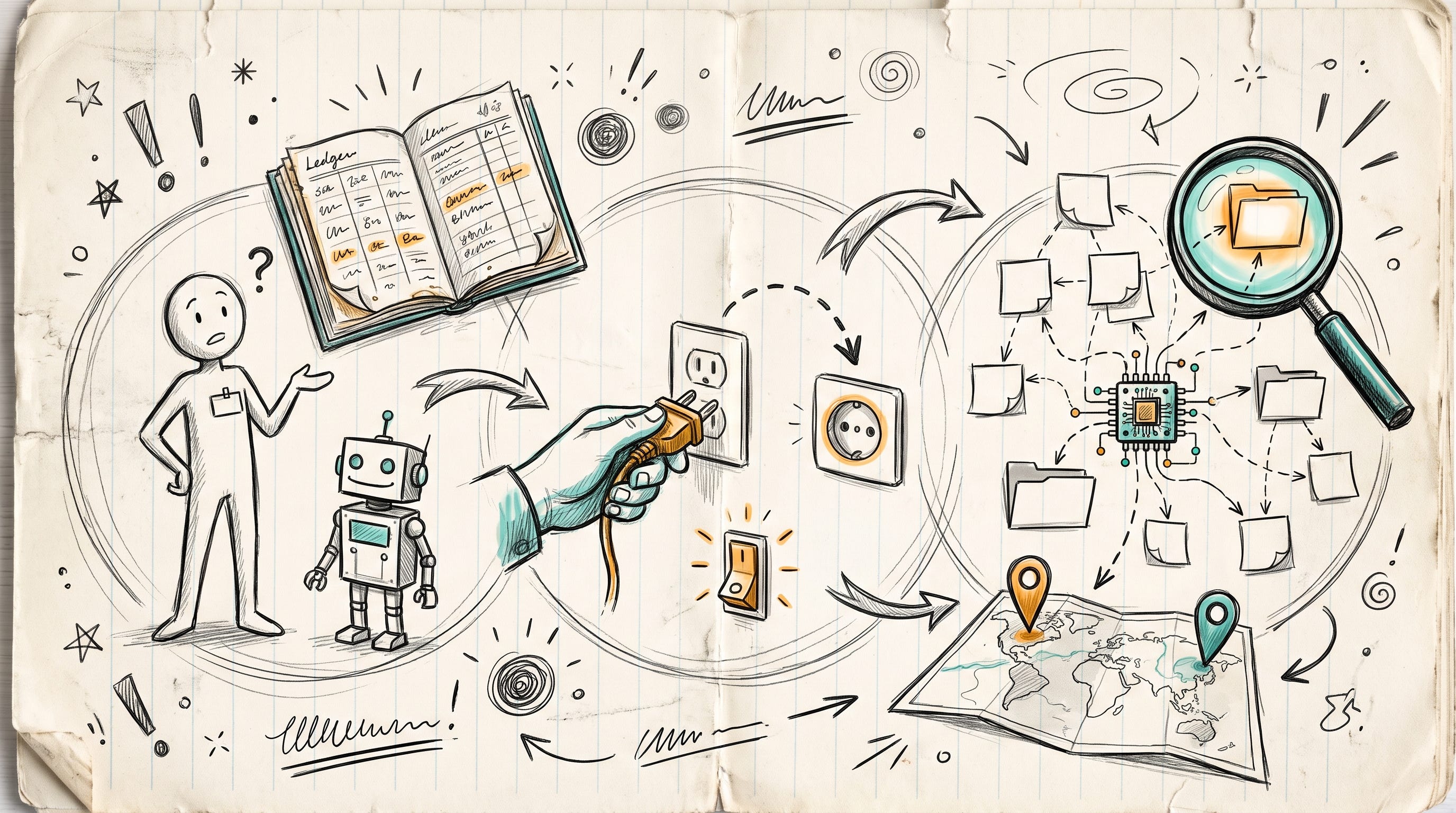
Eleven issues in, a reader asked a fair question: what does this newsletter actually stand for - not piece by piece, but as a whole?
Fair questions deserve plain answers. Everything I write here rests on three convictions. This post names them, so you can decide in two minutes whether The Second Opinion is for you.
Accountability needs a name
A software agent has no duties, no conscience, and no employment contract. It cannot be responsible for anything. A committee can decide, but a committee cannot be accountable either. Accountability without a name is minutes.
So the first question I ask about any AI system is not which model it runs. It is: who owns it? Every consequential AI capability needs a named human owner, and every agent belongs in a register. Not as bureaucracy — as the difference between a three-day answer and a three-week answer when something goes wrong at machine speed.
I’ve spent a large part of my career in governance bodies of a large federal security organization, and the pattern repeats: when a technology feels risky, organizations produce paper. A policy, a board, an approval workflow. Paper calms the room. It does nothing to the systems.
Where I’ve argued this:
Your AI governance has a name problem.

Picture the meeting. The steering committee approves the new agent platform, the AI policy passes, the governance board will convene quarterly. Everyone nods. Twenty minutes, done. And everyone leaves with the comfortable feeling that this organization has its AI under control.
Governance as Code or Not at All

Governance documents, review boards, approval processes. Three instruments that have worked for decades. And three instruments that fail the moment an autonomous AI agent makes a decision in milliseconds.
Sovereignty is the capability to switch
In June, a government switched off two frontier models overnight. The reflex across Europe was: run everything ourselves. I’ve watched an organization follow that reflex to the end — own platform, own models, own infrastructure, and no operating capability. They didn’t build sovereignty. They built a museum.
Sovereignty is a set of capabilities, not a real estate portfolio. Can you audit your tools? Can you switch providers within days? Can you shut a system down without shutting the organization down — and keep working while you do it? An organization that answers yes runs sovereign operations even on international models. An organization that answers no is dependent, even if every server hums in its own basement.
And the least glamorous part is usually the decisive one: the contract. Your infrastructure is only as sovereign as the clauses governing it.
Where I’ve argued this:
Sovereign AI is not a real estate question.

In June, a government switched off two frontier AI models overnight. No warning, no transition period. One export control directive, and teams around the world watched their pipelines go dark. I spent that week answering one question in various forms: shouldn’t we just run everything ourselves?

Context beats model
The canonical demo: “Book my flight to Portland.” The agent books Portland, Maine. The client sits in Portland, Oregon. The agent did not fail because the model was weak. It failed because nothing told it which Portland — and that knowledge lives in your organization, not in any model.
A weaker model with clean context beats the best model with none. Autonomy is earned through context. It is not shipped in a release. Which is why the real budget line for agentic AI is not the platform license. It is the slow, unglamorous work of writing down what your organization actually knows, and getting your data into a state any tool could work with.
Where I’ve argued this:
Agentic AI: The flight to the wrong Portland

Everyone in your peer group is buying autonomous AI agents this year. The demos are good. The slides are confident. The bottleneck is none of the things on those slides.
Your Data Isn't Ready for AI Agents

I’ve spent the last four decades building and overseeing data infrastructure in one of the most regulated environments you can imagine: a federal law enforcement agency with thousands of staff, strict data sovereignty requirements, and zero tolerance for getting classification wrong.
Where these convictions come from
Four decades in public-sector IT, the last years as CTO of a large federal security organization in Germany. I use international AI models extensively — for learning, prototyping, and strategic evaluation. For regulated data and operational casework, they are off the table. Knowing where that line runs is, in my view, the actual leadership skill.
That background shapes the format: every other week, one long-form piece with a second opinion on the AI decisions that reach the executive floor. No course, no vendor angle, no pretense that any of this is simple. Less hype, more criteria.
Quick check
Three questions to test where your organization stands:
✅ Ownership. Can you name the accountable human for your most consequential AI system - within a day? If the answer needs a committee meeting, you have minutes, not governance.
✅ Switching. Have you ever tested a provider switch under time pressure, with real traffic? An untested fallback is a hope, not a capability.
✅ Context. How much of your last AI project went into data and context work — and did that share still surprise you? If preparation dominated the schedule unplanned, the foundation is missing. No model compensates for that.
If one of the three made you pause, you’re the reader I write for.
Hit reply and tell me which one. I read every response.
Andreas