

You’ve approved the pilot. The demo looked impressive. The vendor promised autonomous workflows that plan, execute, and self-correct — no human in the loop between instruction and outcome. Everyone in the steering committee nodded.
Nobody asked what happens to the 340 people currently doing that work.
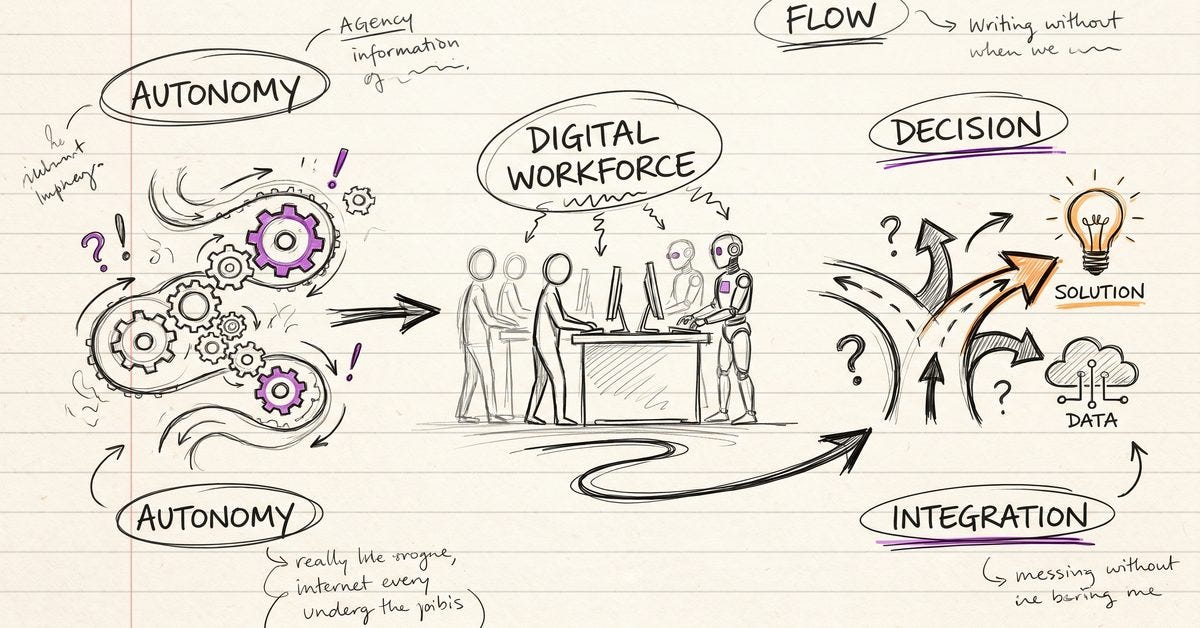
Agentic AI isn’t a chatbot upgrade. It’s an architecture where systems independently plan their approach, select tools, reflect on results, and adjust course. Large financial institutions already use autonomous agents for credit assessments. Consumer goods companies let AI systems orchestrate marketing campaigns — pulling data, segmenting audiences, reallocating budgets — without a human approving each step.
This isn’t incremental change. It’s structural. And in my experience running technology for a 7,000-person federal security organization, three effects are converging that most leadership teams haven’t fully reckoned with.
Self-organizing workflows change what leadership means
Here’s the shift most leaders miss: you’re no longer managing processes. You’re managing goal definitions and guardrails.
An agent receives an objective, decomposes it into tasks, selects appropriate tools, executes, and self-corrects when intermediate results don’t match expectations. In practice: it searches a database, evaluates results against defined criteria, pulls a second source if needed, and produces a report. All in real time. All dynamically adapting.
The question is no longer “who does what.” It’s “what outcomes do I expect, and what boundaries do I set?”
In heavily regulated environments — law enforcement, healthcare, financial services — this creates a particular tension. Governance here means auditable decision chains, revision-proof documentation, clear accountability. An agent that finds its own path must meet those requirements just as rigorously as the case officer on the fourth floor. If it doesn’t, you haven’t gained efficiency. You’ve gained legal liability.
The digital workforce isn’t a metaphor anymore
This is the uncomfortable part. Agentic AI creates a digital workforce. Not figuratively. Operationally.
An agent is goal-oriented. It receives a task, pursues it to completion, reports back. Multiple agents coordinate, assign subtasks to each other, consolidate results. That’s not accidentally similar to a team. It functions like one.
The question leaders need to ask: if three coordinated agents complete in 20 minutes the same research task that took four people two weeks — what follows?
Here’s where I see organizations making a dangerous mistake: they plan agentic AI only as augmentation. A tool that supports existing teams. But the technology compresses experience. What previously required seniority — forming coherent pictures from fragmented information — a well-orchestrated agent system can partially replicate.
This doesn’t make people redundant. But it shifts which competencies matter. Tomorrow’s workforce configures agents, evaluates their outputs, and handles the exceptions no algorithm can resolve. That’s potentially a gain. But only if the organization designs this transition deliberately.
Three strategic options: reposition people into new roles that agentic AI creates. Limit deployment to defined areas, protecting human expertise where it’s irreplaceable. Or acknowledge that in some areas, the digital workforce will absorb capacity gaps from demographic change. Most organizations will need all three simultaneously.
When machines prepare decisions nobody questions
This is the most consequential shift. Agentic AI doesn’t just prepare decisions. In certain contexts, it makes them.
Autonomy levels are the key. At the lower end: advisory agents that collect information and present options. A human decides. At the upper end: fully autonomous agents that analyze, evaluate, decide, and act. Reality lives in the spectrum between.
The temptation is obvious: if the agent was correct in 98% of the first 500 credit decisions, why keep the human sign-off? The answer, for anyone who’s worked in regulated environments: because the 2% errors aren’t randomly distributed. They cluster in complex, ambiguous, context-sensitive cases. The ones that affect lives.
What leaders need now is a differentiated governance model for decision autonomy. Not one model for the entire organization — but a clear matrix: which decisions can an agent make autonomously? Where must a human approve? Where shouldn’t the agent even recommend?
From my experience deploying multiple AI systems in a large federal agency: building this differentiation takes time. Significant time. But it’s the foundation that prevents agentic AI from becoming a legal and reputational risk.
What you can do this quarter
Four areas deserve immediate attention:
Governance before technology. Before deploying your first agent, establish the rulebook. Which decisions may be automated? Who’s liable when an agent is wrong? How do you ensure traceability? These questions protect you from the moment an autonomous process makes a decision you can’t explain.
Build competence, not just technology. The biggest investment isn’t the platform license. It’s your people’s understanding. Those who grasp what an agent can and cannot do make better deployment decisions. Start with pilot projects that have clear learning objectives — not lighthouse projects with executive ambitions.
Secure experiential knowledge. When agents take over routine tasks, the tacit knowledge embedded in those routines disappears. The case officer who’s reviewed applications for 15 years knows things no manual captures. Document that knowledge before it’s lost. It’s exactly what agents need to be configured well.
Stay flexible. The augmented scenario — humans and agents working in hybrid teams — is most likely. But planning for only one scenario repeats the mistake of everyone who said in 2019 that language models would remain niche.
The technology will evolve in the next 12 months. Your governance must keep pace. That requires not just technical competence — it requires organizational learning capacity.
And that, ultimately, is the real leadership challenge.